
What was not tested matters too
A report that only discusses the results it was given will miss the question it should have asked. Naming the missing tests is part of reading the ones that are there.
Every interpretation is bounded by its input. Hand it a panel without a marker, and a careless reading behaves as if that marker were normal. A careful one says what it could not see.
An example: iron
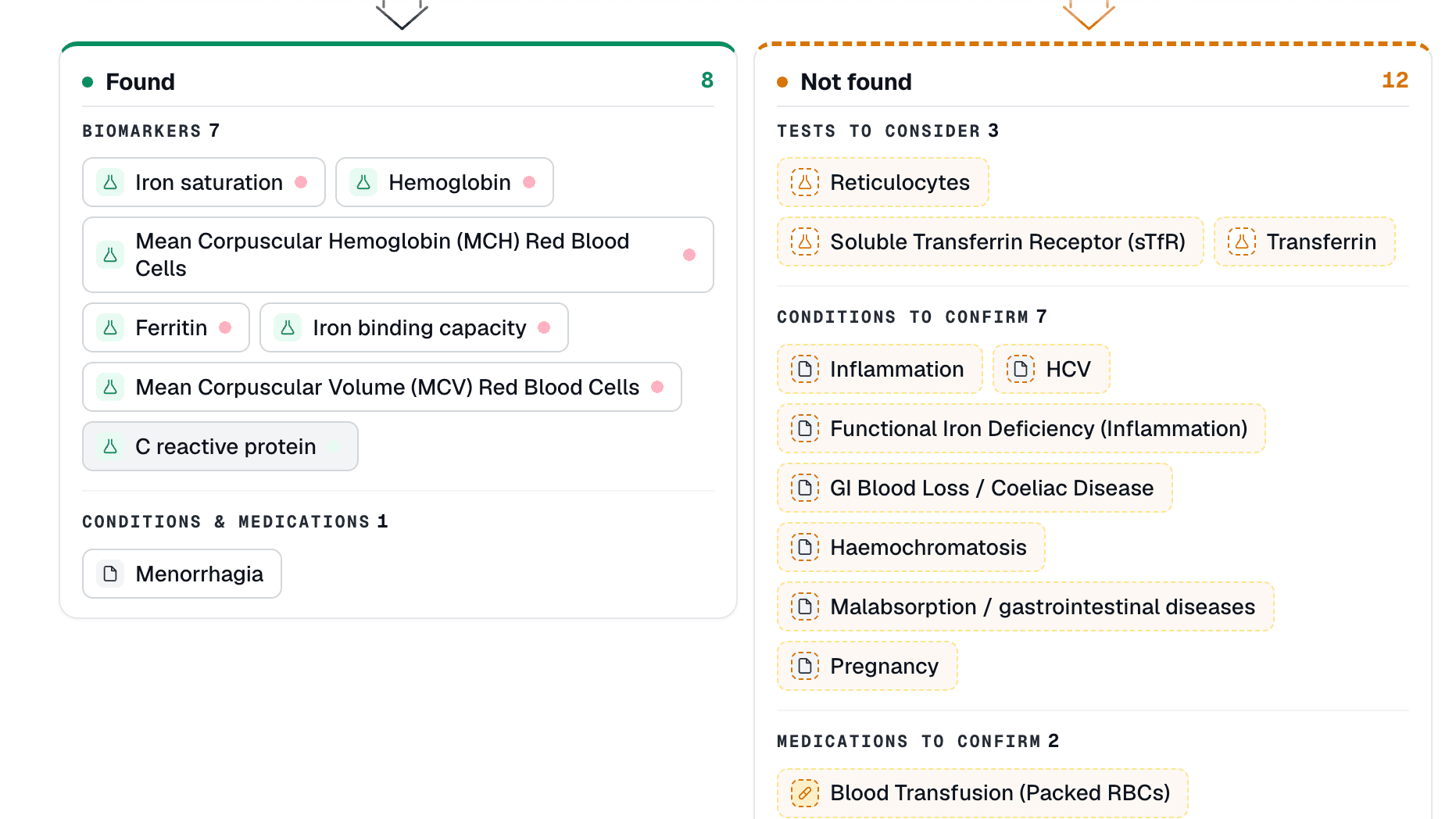
Ferritin is the usual first marker for iron stores, but it also rises with inflammation. A ferritin in the normal range next to an elevated CRP does not rule out iron deficiency; it can hide it. Reading that pair correctly means saying what would settle the question — transferrin saturation, a reticulocyte count, sometimes a soluble transferrin receptor — rather than stopping at “ferritin normal.”
Found and not found
Vitrubo lays the evidence for each finding out in two columns. What was found: the markers, conditions and medications in the record that support it. What was not found: tests that would confirm or rule it out, and conditions or medications worth checking. The second column is often the more useful one for a clinician, because it is the part a busy reading skips.
- Tests to consider — the next measurement that would change the picture.
- Conditions to confirm — explanations the data is compatible with but does not establish.
- Medications to confirm — treatments that would change the reading if they were being taken.
The doctor's view of the Health Report shows this evidence layout on every finding.
This article is general information, not medical advice. Talk to a clinician about your own results.