

Ask the record itself.
A validated AI chat grounded in the user's own record — values, trends and history, never generic advice. What each marker means, how it connects to how they feel, and how it has changed over time. It builds understanding; it never diagnoses and never replaces a doctor.
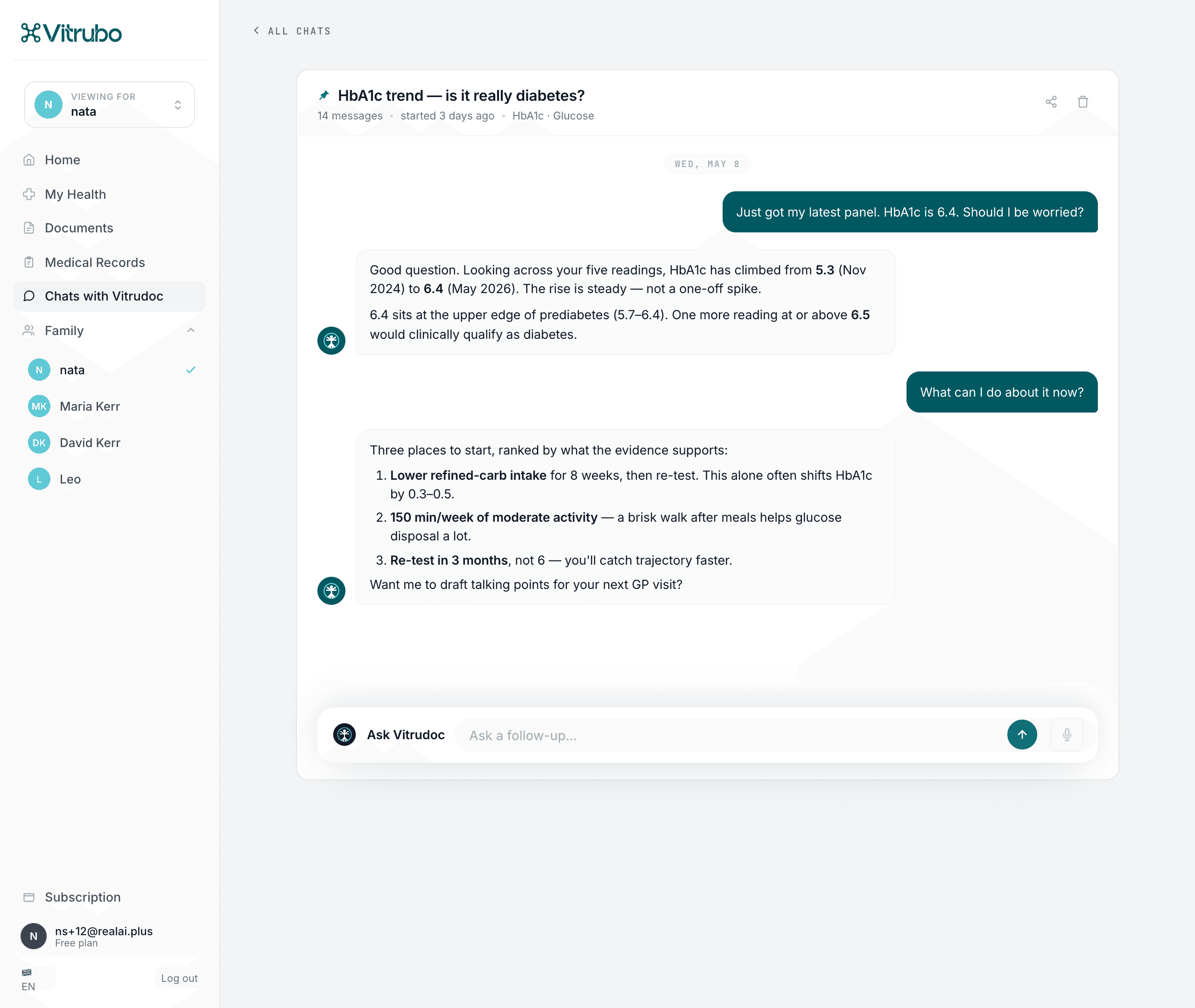
What it answers.
What the biomarker is, your value, the reference range — and what it means for you specifically.
“Low energy, dry skin — what could this relate to?” — and it finds the relevant markers.
How a marker moved from test to test — rising, falling or stable.
“How are my results overall?” — leads with what matters, not a printout of every row.
Where to find things, how to upload a test, where to look — navigating the interface.
Symptoms, conditions, medications, allergies, surgeries and family history the user mentions land in their chart.
From question to verified answer.
A question, or a marker
The user types, or presses “Tell me more” on a biomarker — which carries that marker's context in with it.
Understands, picks its tools, assembles
It reads the question, chooses which tools the answer needs, and builds it — never leaving the boundaries below.
User record (FHIR)
Labs, diagnoses, medications, reports, symptoms — the one place every answer is drawn from.
A clear, plain-language explanation
Grounded in that record, at the depth the question asked for.
* precise calculation and memory run on separate helper models.
What it deliberately doesn't do.
- never diagnoses or claims the user has a specific condition;
- no probabilities, no disease “risk scores”;
- never prescribes medication or supplements, never advises changing them;
- says “associated with”, not “caused by” — causality is never asserted;
- on an alarming value, calmly suggests seeing a doctor — no panic;
- answers only about health and labs, not off-topic questions;
- writes only confirmed facts to the record — if wording is ambiguous, it asks first.
What an answer looks like.
Plain language and structure — headings, lists, the key point first.
At most one clarifying question at a time — it never floods the user with questions.
Depth matches the question: short gets a short answer, complex gets a detailed one.
Configurable by design.
Guardrails per deployment
The boundary set is defined in system instructions in code and tuned per partner: allowed topics, escalation wording, what the assistant must never say.
Capability switches
Memory, precise calculations, app guidance, and writing to the record can be switched on or off for a given integration.
Knowledge sources
The deterministic connections layer is built on medical guidelines. Partner guidelines, protocols, and panel structures can be plugged in as additional sources.
Answer style
Language, depth, and tone are configured per audience, patient facing or clinician facing.
See Vitrudoc on a real record.
A demo call, test access for your team, and an open API sandbox.