

Read the patient, not the folder.
Values, flags, trends and connected conditions and medications, organised before the visit. Patients share a profile — the record arrives structured, with originals kept.
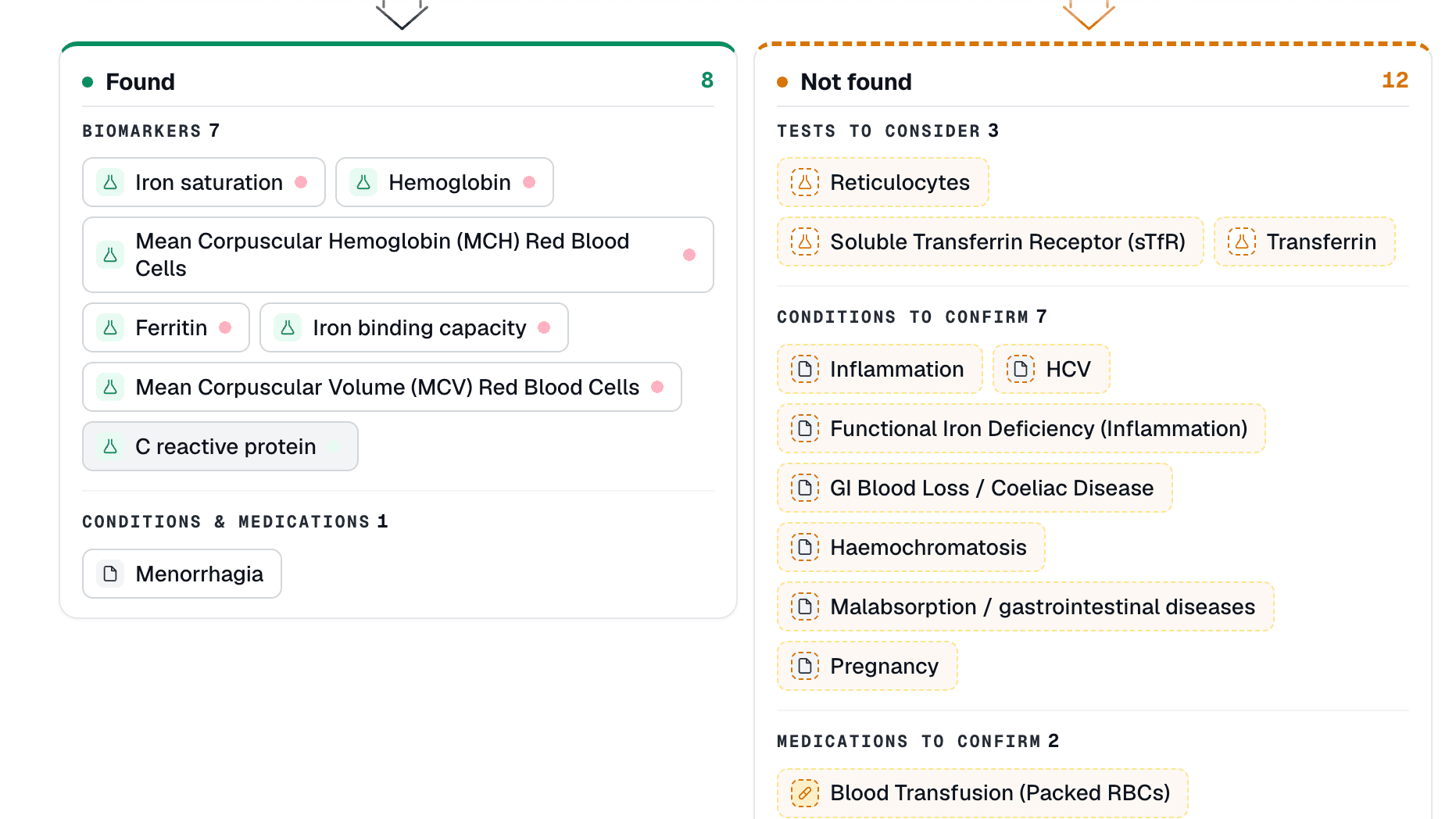
The record arrives ready.
Values, flags, trends and connected conditions and medications, organised before the visit. Patients share a profile; nothing to chase.
It does not diagnose and does not validate results. It surfaces, organises and contextualises results that are already validated.
Every statement links the guidance it rests on; one click opens the publication itself.
It knows which tests are worth adding. And which are worth re-testing.
When the reasoning reaches for a marker and finds nothing, it says so — with the reason attached.
Urine albumin
— never taken —Reticulocytes
— never taken —Alkaline phosphatase
— never taken —Markers the guidance pairs with what was measured, missing from the record.
Vitamin D
never recheckedB12 · folate · homocysteine
2–3 years oldCRP
13 months staleA value can be too old to lean on. The CRP on file is thirteen months older than the ferritin it is meant to validate.
Clinical reasoning, full data.
The doctor view keeps clinical language: values, flags and differentials, tests to consider — plus unconfirmed conditions and medications relevant to the case. It flags patterns that are easy to miss: values drifting together across draws, markers that contradict each other, gaps worth closing.
A View as: Patient / Doctor switcher sits inside every report.
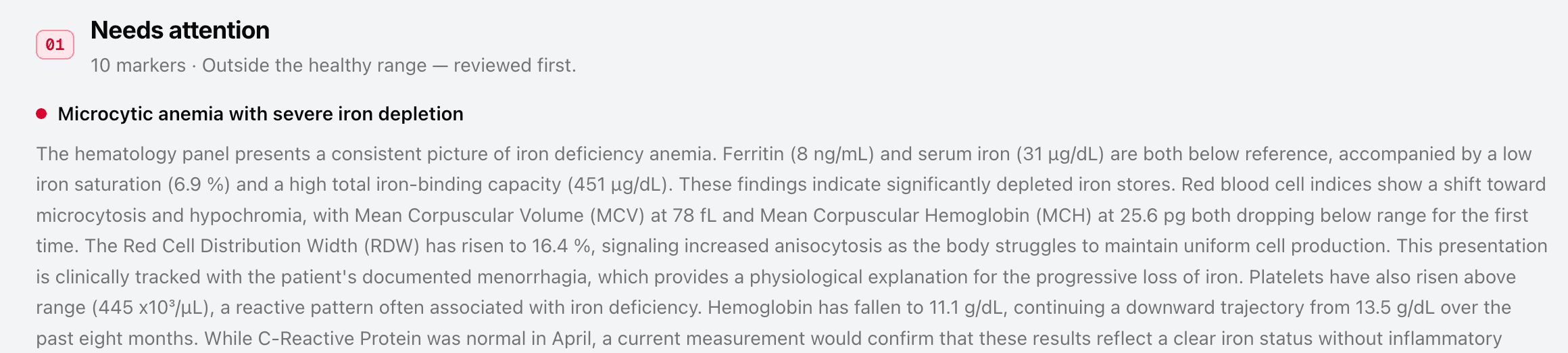
It drafts. You decide.
Vitrubo does not diagnose and does not validate results. It surfaces, organises and contextualises what is already validated — the reasoning is inspectable, and the conclusion stays with the clinician.
How the glass box worksSee a case at clinical depth.
A walkthrough on a real record, at the depth you would read it.