

For labs · clinics · health apps
Blood test software that reads the whole panel, not one line.
Vitrubo turns a blood test into a drafted interpretation: values parsed from PDF, HL7 or FHIR, mapped to LOINC, read against the patient's history and named medical guidance, and handed to the clinician to review and sign. White-label reports and a portal for staff and patients, or JSON through the API.
- HIPAA compliant
- GDPR compliant
- Encrypted in transit and at rest
- HL7 · FHIR R4
Blood test software built on the standards a lab already runs.

LOINC codes
Every value from a blood test lands on one reference standard, whichever lab produced it. Units are made comparable across laboratories.
In and out
HL7 and FHIR R4 in; FHIR and JSON out. The software speaks the standards a lab already runs.
Native record
One FHIR R4 record per person, every result coded and dated, the source document kept. HIPAA agreement for US deployments, GDPR Article 28 terms as standard.
Records, on premises
A hospital program across roughly 100,000 anonymised records. Nothing left the perimeter.
Who needs blood test software?
The same blood test software sits at a different step of the process for each buyer. In every case the professional signs; the software drafts.
A comment beside every flagged result.
Drafted in the style the lab already writes. The scientist reviews and approves it inside the existing release step, and the right follow-up test is raised while the sample is still fresh.
The whole history before the consultation.
Every blood test, letter and discharge summary parsed, coded and merged into one record. Patient reports under your practice brand, trends across years on a single line.
Blood test interpretation inside your product.
Embed it, bundle it or resell it. Every new result regenerates the report, which gives users a reason to come back with each test.
What blood test software does with a panel.
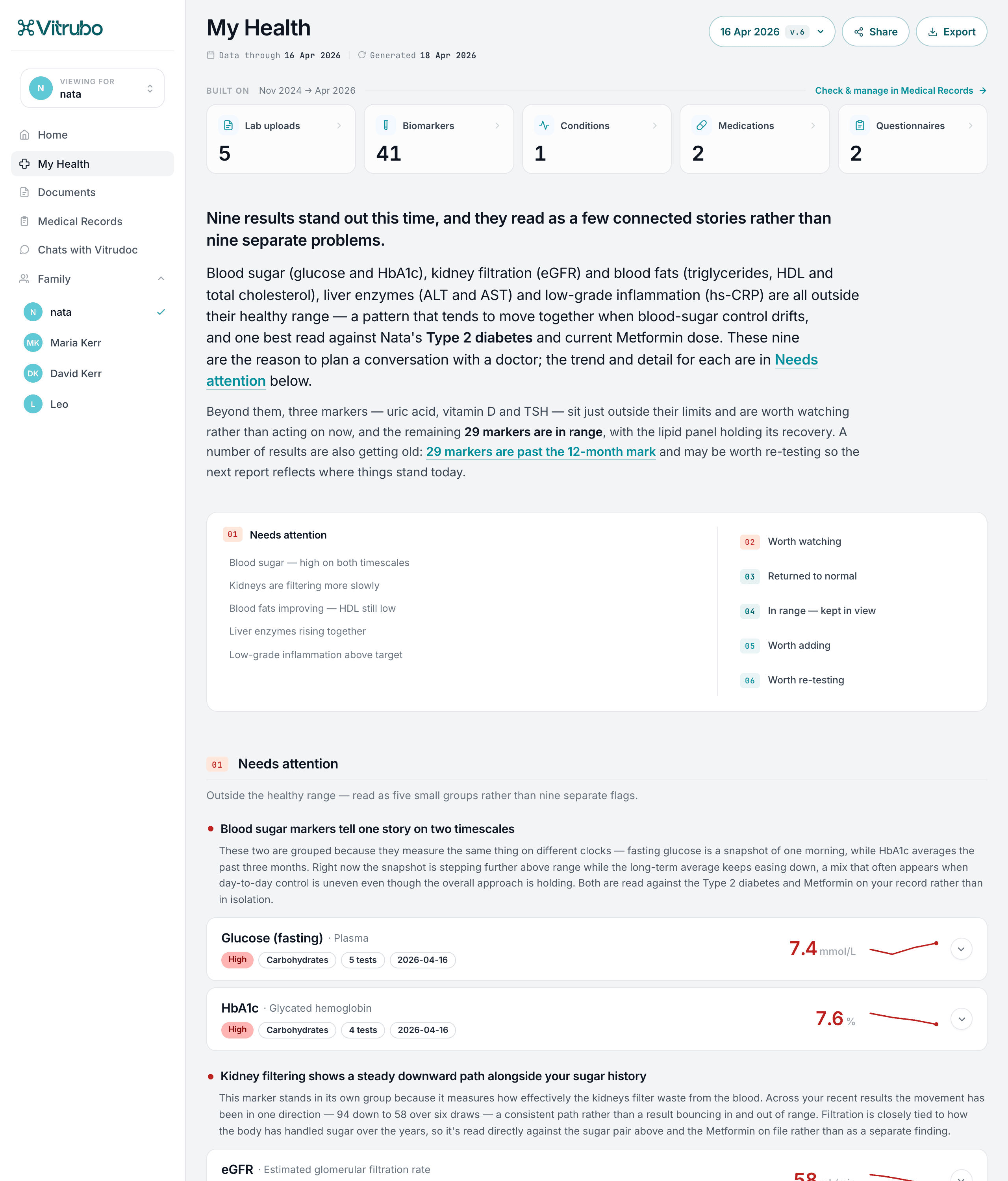
A blood test arrives as values against ranges. The software reads them together: which markers move as a group, what the medication list changes, what a borderline value means beside two other borderline values. Out comes a drafted interpretation with next steps, not a longer table.
Different labs, different units, one line. Results are normalized to a single standard, so the history of a marker reads as a trend rather than a folder of formats. A value drifting for years, which looks normal in any single blood test, becomes visible.
Clinician and patient PDFs carrying your logo, headers and disclaimers. A role-based portal with patients, trends and reporting controls under your brand. Choose JSON plus PDF, portal only, or both.
Containers on your infrastructure or a private cloud. You own the keys; Vitrubo ships versioned builds and has no access to your data. Models see values and an internal ID, never a name.
The predictable part of blood test review is drafted before anyone opens the file. No LIS project is needed to start: send HL7, PDF or JSON and receive a report. Staff attention goes to the results that need judgment.
Connect the software to your LIS, EHR or portal through HL7, FHIR or the API. Interpretation, reporting and follow-up run automatically, so turnaround falls without adding headcount.
A lab report a patient can read.
Use the software to read lab results, blood, urine and allergy panels alike: flag deviations, follow change across draws, and hand the patient a report in plain words. What stands out, why it is grouped that way, and what to discuss with a doctor. Clinical depth stays one click away for the professional.
Connects to the systems you already run.
Full integration.
Plug the software into the systems you already run. Results flow in as HL7 or FHIR, the drafted interpretation flows back into the same systems, and follow-up is scheduled from the record rather than by hand.
PlatformWhite label, no integration.
Dedicated web interfaces for the laboratory, the clinician and the patient, under your brand. No engineering project required to begin.
API first.
Teams with their own portals take the API alone: structured results and the interpretation as JSON, straight into your LIS or EHR. Recognition, normalization and interpretation, together or one at a time.
Interface and API, for every customer.
Results mapped to LOINC, units made comparable, the record kept in FHIR R4. Containers on your infrastructure, your keys.
Why not just ask a chatbot?
Because a blood test is not a prompt.
A general-purpose model
- Not designed or validated for laboratory work; a general model is a writing tool, not blood test software.
- Struggles with messy, multi-page lab PDFs and reads a number wrong without noticing.
- No consistent normalization: units, reference ranges and panels differ from lab to lab and stay that way.
- Weak on longitudinal history across labs; each report is read on its own.
- No source behind a statement, so nothing for a clinician to check.
Purpose-built blood test software
- Lab-native ingestion: robust parsing of PDF, photo, HL7 and FHIR. Numbers are computed by deterministic code, never written by a model.
- A normalization engine for units, reference ranges and LOINC mapping, so a blood test from any lab lands on the same scale.
- Several models review the same case; disagreements are resolved and omissions caught before a draft is shown.
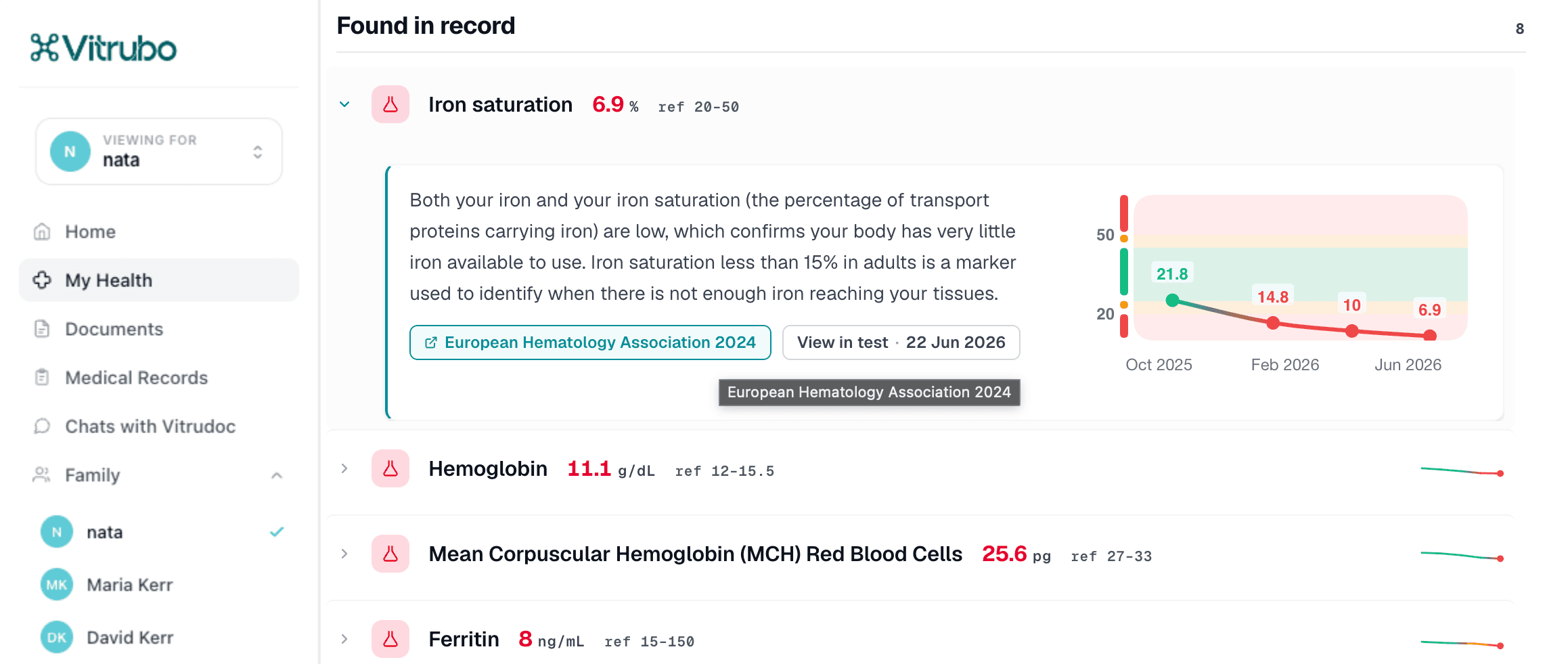
- Cited, claim by claim: every statement links the medical guidance it rests on. One click opens the publication.
- Built for follow-up: the next test is raised with its reason attached, and a value still current on file is not ordered twice.
Every statement rests on named medical guidance. Each chip opens the same guideline page a clinician would read.
From first call to production, on your own blood tests.
An evaluation runs on your result formats, not on ours. Six steps, none of them a commitment until the last.
Talk to the team
A short call about your panels, result formats and the step in the process where the software should sit.
Sandbox and API docs
Test access for your team, with the API contract and sample payloads.
Run your own blood tests
Send real formats, anonymised. Blood, urine and allergy panels, PDF or HL7.
Validate the output
Your scientist or clinician reviews the drafts against their own reading, alone or together with us.
No commitment at this stage
Evaluation is an evaluation. Configuration of comment style, ranges and branding happens here.
Production when ready
Inside your perimeter or a private cloud, connected to the LIS or EHR, or portal-first.
Questions about blood test software.
Every statement the software writes links to the medical guidance it rests on, so the basis for a claim can be checked rather than trusted. Numbers, units, ranges and flags are computed in code; several models review the same case and their disagreements are resolved before a draft is shown. A clinician or lab scientist reviews and signs. The software prepares the ground; it does not decide.
A structured FHIR R4 record of the panel, a drafted interpretation with its sources, trends for every marker across previous results, and two views of the same analysis: clinical reasoning for the professional and plain language for the patient. Delivered as PDF, in the portal, or as JSON through the API.
A HIPAA business associate agreement for US deployments, a GDPR Article 28 processing agreement and Standard Contractual Clauses as standard. Data is encrypted in transit and at rest, identity never enters the prompt, and in-perimeter deployments keep key management with you.
No. Vitrubo is not a diagnostic device and does not select treatment. It drafts a reading, organises the history and names the tests to consider; the decision and the signature stay with the professional. For patients it is educational context to bring to an appointment, not medical advice.
Yes. White-label branding for reports and portal, comment style matched to the way your lab already writes, custom reference ranges per laboratory, and a connection to the patient portal you run today. Each deployment gets its own configuration: guardrails, capability switches and answer style per audience.
Four steps. Parse: documents, photos and feeds are read, with numbers computed by deterministic code. Structure: the result becomes a FHIR R4 record mapped to LOINC and related codes. Understand: values are read together, against the patient's conditions, medications and history, with medical guidance cited claim by claim. Deliver: report, portal, doctor and patient views, or JSON.
PDF, photos and scans, HL7, FHIR R4 and JSON through the API. Blood, urine and allergy panels arrive as values; hospital records, prescriptions and notes are read as context for the interpretation.
The drafted comment appears in the specialist's own system for review, and after approval reaches the patient through the channel the lab already uses. Deeper reasoning, trends and sources stay available on demand in the portal or as a branded PDF.
HL7 and FHIR R4 in, FHIR and JSON out, connected to laboratory information systems, electronic medical records or your own portal. Containers run on your infrastructure or in a private cloud; you own the keys and Vitrubo has no access to the data.
With a demo call, followed by test access and a sandbox with API documentation. Your team runs its own anonymised panels and validates the drafts before any commitment; production follows when you are ready.
Demo cases
Invented people, real product. Every case is a synthetic record with a stock portrait: no real patient, no real result. The reports are live.

Robert Hensley
58A year of CKD follow-up with full context supplied.

Emily Carter
34Five visits over nine months with no diagnosis supplied.

Ryan Hayes
30Fifteen months of lifestyle change. The direction of travel is read.
See it on your own blood tests.
A walkthrough on your result formats and release workflow, sandbox access for your team, and a drafted report on your own panels.