

For clinics · health programmes · hospitals
A health assessment, read as one record and one report.
A comprehensive health assessment produces a folder: lab panels, imaging reports, a consultation note, questionnaires. Vitrubo is the reading layer the programme adds: every document read into one FHIR R4 record and returned as one report, read against the previous year's assessment. For the clinics, executive health programmes and hospitals that run it, and for the person who holds the folder.
- HIPAA compliant
- GDPR compliant
- Encrypted in transit and at rest
- HL7 · FHIR R4
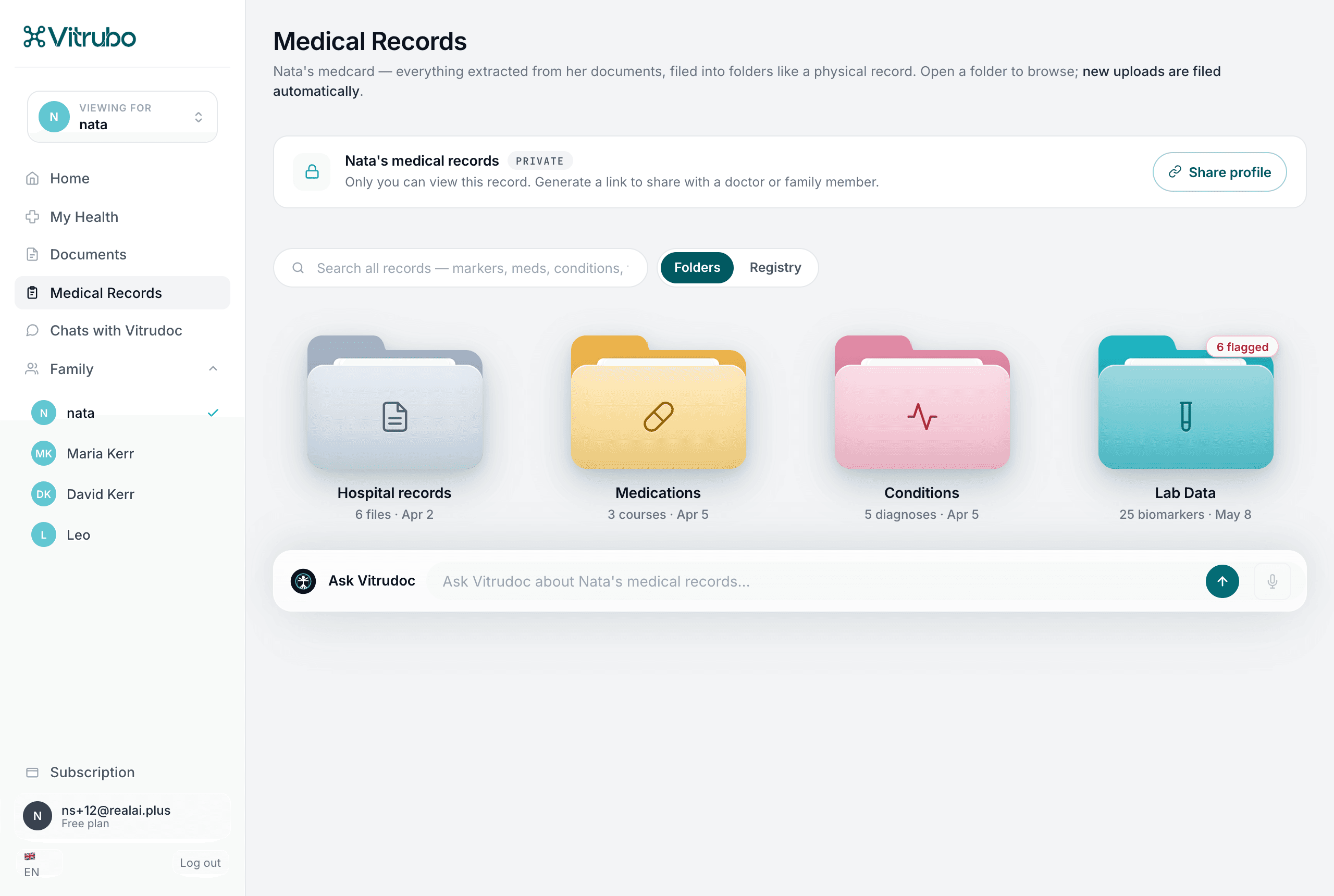
What a health assessment leaves behind, and what reads it.

LOINC codes
Each value from the assessment's lab work lands on one reference standard, whichever laboratory the programme used that year. A change of lab partner between two assessments keeps one history.
Sources behind one view
Up to 30 named publications can sit behind a single view of one marker. The chip beside each statement opens the guidance it rests on, for the clinician who signs and the client who reads.
Native record
One FHIR R4 record per person, every result coded and dated, the source document kept. HIPAA business associate agreement for US deployments, GDPR Article 28 terms and Standard Contractual Clauses as standard.
Records, on premises
Roughly 100,000 anonymised hospital records read inside a clinical programme without leaving the perimeter. Numbers, units, ranges and flags are computed by deterministic code, never written by a model.
Who runs health assessments, and what the reading adds.
A private clinic, a hospital assessment department and a longevity or wellness provider each sell a day of tests and a consultation as an annual health check. Vitrubo does not perform the assessment; it reads what the day produces into one record and one report. In every case the professional signs and Vitrubo drafts.
The consultation starts with the whole record.
The doctor who closes an executive health assessment has an hour and a folder. Vitrubo reads the folder first: the panels as values, the imaging and consultation notes as context, this year's results against last year's. The clinician view shows what moved, what it connects to and which tests are worth considering, so the hour is spent on the conversation rather than on the paperwork.
One report from many departments.
A hospital health assessment passes through the laboratory, radiology, cardiology and a consulting physician, each producing its own document. Vitrubo reads them into one FHIR R4 health record for the person, delivered inside the hospital's perimeter and connected to the LIS and EHR. What the client receives is one report, not a stack of departmental print-outs.
The second assessment is the one that pays back.
A longevity programme's value is in the comparison: what this year's assessment says that last year's did not. Vitrubo reads each assessment against the earlier ones, names which values came back to normal and which are worth watching, so the client's health reads as a direction rather than a snapshot, and regenerates the report with every new result between visits. The client has a reason to return, and the programme has a story that continues.
What Vitrubo does with a health assessment.
A health assessment does not end in a single PDF. Blood, urine and allergy panels arrive as values. Imaging reports, the consultation note, questionnaires and prescriptions are read as context: a medication on file changes how a marker is read, and a finding in a radiology report is known when the labs are interpreted. Nothing in the folder is left out because it was the wrong format.
The point of repeating an assessment yearly is the comparison, and the comparison only works if the two years are on one scale. Every value is normalised to LOINC and UCUM units, so a marker measured at one lab in one year and another lab the next reads as one line. Slow drift that looks normal in any single assessment becomes visible across three.
Flagged results are grouped into connected stories and placed in four zones: needs attention, worth watching, back to normal, always normal. A value that came back into range since the last assessment is named as such rather than quietly leaving the list, and a value that has never moved is said to be steady.
A clinician view with the full reasoning, connected conditions and medications, and tests to consider. A plain-language view for the client, written so the folder makes sense without a medical dictionary. Vitrudoc, an AI chat grounded only in that person's own record, sits beside either view. The same analysis in two registers, never two analyses.
Every statement links to the medical guidance it rests on: EHA, WHO, NICE, KDIGO and BSH among others, up to 30 sources behind one biomarker view. A chip opens the publication. Nothing in the health assessment report is asserted without a source the signing clinician can check.
The report is not written once and filed. A result that arrives between two assessments, a follow-up test, a health app upload or a hospital discharge letter, regenerates it against the whole record, and previous versions stay as history. What the client reads before next year's visit is a reading of everything since the last one.
A year of documents, read as one person's record.
Robert Hensley is 58 and has been followed for chronic kidney disease over a year of quarterly visits, with his full context supplied: history, symptoms, medications and diagnosis. Of the three live reports this is the closest to a health assessment: many documents from many dates, read together into one health record. The report reads declining kidney function alongside its complications, recognises that several markers that used to be abnormal have improved, and marks which results are stale and worth re-testing. Open the clinician view for the reasoning and the patient view for the same reading in plain language.
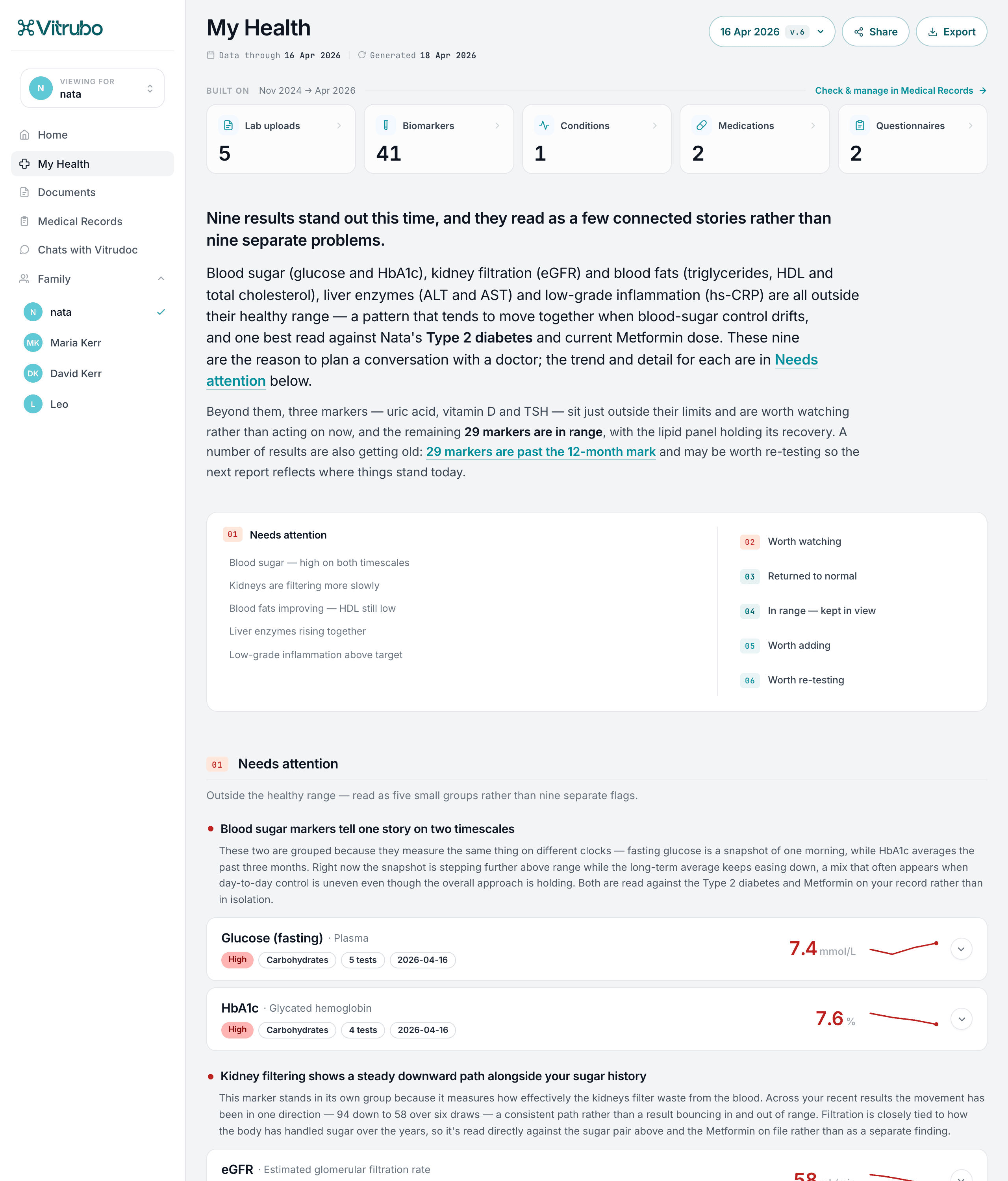
Connects to the assessment programme you already run.
Full integration.
Lab results arrive as HL7 or FHIR R4, imaging and consultation reports as documents, and the drafted reading flows back as FHIR or JSON into the EHR the executive health programme already uses. No result from a health assessment is re-keyed by hand.
PlatformWhite label, no engineering.
A role-based portal and PDFs under the programme's brand, for the clinic, the clinician and the client. A folder of scanned results uploaded as PDFs or photos is read the same way as an HL7 feed.
API first.
Programmes with their own client portal take the API alone: the structured record and its interpretation as JSON, ready to render. Recognition, normalisation and interpretation together or one at a time.
Standards in, standards out.
LOINC for every value, UCUM for units, the record kept in FHIR R4. Containers on your infrastructure or a private cloud, your keys.
Why not paste the results into a chatbot?
Because a health assessment is a record, not a prompt.
A general-purpose model
- Reads the values you paste and nothing else: no last year's assessment, no imaging report, no medication list, no health history.
- Misreads a decimal or a unit in a multi-page lab PDF without noticing, and the wrong number becomes part of the answer.
- No normalisation: a marker measured in two units at two labs in two years stays two numbers.
- Confident prose with no source behind it, so nothing for the signing clinician to check.
- Answers once. Next year's assessment starts the conversation from nothing.
Vitrubo's reading of a health assessment
- Numbers, units, ranges and flags computed by deterministic code, never written by a model.
- Every value mapped to LOINC and UCUM, so this year's and last year's panels land on one scale.
- Several models cross-check the same case; disagreements are resolved and omissions caught before a draft is shown.
- Every statement links the named medical guidance it rests on. One click opens the publication.
- Read against the whole record, imaging and notes included, grouped into connected stories in four zones, regenerated with every new result.
Every statement rests on named medical guidance. The chip beside it opens the same publication a clinician would read.
From first call to production, on your own clients' assessments.
An evaluation runs on the folders your health assessment programme already produces, in your formats. Six steps, none of them a commitment until the last.
Talk to the team
A short call about your executive health programme, its departments and the point in the day where the reading should sit.
Sandbox and API docs
Test access for your team, the API contract and sample payloads for lab results in PDF, HL7 and JSON, and for imaging and consultation reports as documents.
Run your own assessments
Send real folders, anonymised. Two consecutive years from the same client are the most telling.
Validate the output
Your physician reads the drafts against their own reading of the same assessments, alone or together with us.
No commitment at this stage
Configuration of ranges, report style and branding happens here. An evaluation is an evaluation.
Production when ready
Inside your perimeter or a private cloud, connected to the LIS and EHR or through the client portal.
Questions about the health assessment.
In the market the phrase means a day, or a half day, of tests and a consultation sold by a private clinic, a hospital assessment department or an executive health programme: blood and urine panels, imaging, a cardiac test, questionnaires on lifestyle, family history and general health, and a consultation with a physician at the end. Most programmes repeat it yearly. Vitrubo does not perform any of it. It is the reading layer the programme adds so that everything the day produces is read as one record, and the layer a person can use to understand a folder of results they already hold.
The reading. The assessment produces the documents; Vitrubo reads them into one FHIR R4 health record for that person and returns one report. Lab panels arrive as values, so trends and ranges are computed. Imaging reports, the consultation note, questionnaires and prescriptions are read as context, so a marker is interpreted with the medication and the finding that bear on it. The report comes in two views, one for the clinician who signs it and one for the client who reads it.
Four steps. Parse: each document arrives as a lab PDF, a scanned report, a photo, an HL7 or FHIR feed or JSON, and numbers, units, ranges and flags are computed by deterministic code. Structure: every value is mapped to LOINC and its unit to UCUM, and the document becomes part of one FHIR R4 record for that person. Understand: values are read together, against the previous assessment and the notes on file, with named guidance cited claim by claim. Deliver: a clinician view, a client view, a PDF or JSON through the API.
On one scale. Every value from every year is normalised to one of 17,000+ LOINC codes and to UCUM units, so a marker measured at one laboratory in one year and at another the next reads as points on one line rather than two formats. The report then says which values moved, which came back to normal and which have never moved, and places each in one of four zones. This is the comparison an annual health check is sold on. Reference ranges are kept per laboratory, because the range that applies to a value is the one the lab that measured it published.
Because the assessment's value is in the comparison, and the comparison is the part most programmes leave to the client. A folder of departmental print-outs handed over at the end of the day is hard to read and harder to compare with last year's folder. When the programme returns one report that names what changed since the last health assessment, the consultation has more to say, the client has a reason to come back, and the executive health programme's value compounds rather than resetting each year.
The clinician view is the whole health record before the appointment: flagged results grouped into connected stories, each with its trend across assessments, the conditions and medications it connects to, the guidance it rests on one chip away, and the tests worth considering next. The physician reads it, agrees or disagrees, and signs. Vitrubo drafts; it does not decide. The hour with the client is spent on the conversation, not on reconciling the departmental reports.
No. Vitrubo is not a diagnostic device, does not select treatment and does not replace the physician who closes the assessment. It drafts a reading of the results that are there, organises the record and names tests worth considering; the clinician reads and signs. For a person reading their own assessment it is educational context to bring to the next appointment, not medical advice.
No. Vitrubo runs no clinic, no laboratory and no imaging, and sells no assessment of its own. The assessment is performed by the clinic, hospital or programme, and Vitrubo is licensed to them as the reading layer, delivered under their brand. Access is by invitation after an evaluation on your own anonymised folders; there is no self-serve signup and no published price list.
Any laboratory result reported as a value, in any panel: metabolic and lipid panels, blood count, inflammation, iron and vitamin status, thyroid and other hormones, kidney and liver markers, urine and allergy tests. Imaging reports, ECG and other cardiac reports, the consultation note, lifestyle and family history questionnaires, prescriptions and hospital records are read as context. A document read as context is not scored; it is known when the values are interpreted.
Containers run inside the hospital's perimeter or in a private cloud; the hospital owns the keys and Vitrubo has no access to the data. Lab results arrive from the LIS as HL7 or FHIR R4, documents from the EHR, and the drafted reading flows back as FHIR or JSON into the same EHR or into a role-based portal under the hospital's brand. Identity never enters the prompt: the models see values and an internal ID. A HIPAA business associate agreement for US deployments and GDPR Article 28 terms.
Yes, through a clinic, programme or health app that offers Vitrubo under its own brand. The person uploads the folder as PDFs or photos and reads the plain-language view: what stands out, why it is grouped that way, and what to discuss with a doctor. Earlier assessments uploaded alongside are read into the same history, so one assessment is read on its own and two or more are read as a line. Vitrudoc, the AI chat grounded only in that person's own record, can answer questions about the folder beside the report.
With a call, then sandbox access and API documentation. Your team runs its own anonymised folders, ideally two consecutive health assessments from the same clients, and your physician validates the drafts against their own reading. There is no commitment at that stage; production follows when you are ready, inside your perimeter or a private cloud, connected to the LIS and EHR or through the client portal.
Demo cases
Invented people, real product. Every case is a synthetic record with a stock portrait: no real patient, no real result. The reports are live.

Robert Hensley
58A year of CKD follow-up with full context supplied.

Emily Carter
34Five visits over nine months with no diagnosis supplied.

Ryan Hayes
30Fifteen months of lifestyle change. The direction of travel is read.
See it on your own clients' assessments.
A walkthrough on the folders your programme already produces, sandbox access for your team, and a drafted report on your own anonymised assessments. Or open a live report first.